


Under the Apple Tree
Why do I write...so much?
Child number 4, an imperious fairy queen, fixes me with her candid eye and asks, ‘Why do you write so much?’
Her tone is nicely balanced between interested enquiry and accusation. Now I’m a firm believer in telling children the truth (most of the time; there are exceptions as every parent knows,) so now I’m trying to answer this devastatingly simple question.
Why do I write so much? Those last two words surely contain a thread of judgement. Does she think it’s self-indulgent? Or that there’s a secret to it that she’s not aware of? Am I keeping some stash of joy from her, like hiding the sweets at Christmas?
I don’t find the question easy because there are so many strands to the answer. Looking back, I began writing because I had an idea for a book...two children find an egg, it hatches into a dragon... That particular version still resides on an ancient computer and was never published. But it was the starting point for a later book, Hurtling Wiffie, which is out and about on Amazon. I worked with Roj Haines on that first book, and we became collaborators on a number of others, notably, Princess Victoria’s War. I think the chance to talk things over, share what we’d written was vital. Any budding authors out there? Don’t be shy about showing your work to others.
I guess that first book got me going... I had more ideas... I researched theory... I handed a manuscript to my daughter, a professional Book Coach. She saw some merit in it, gave me detailed, constructive advice (in writing!). I acted in her advice which was eye-opening. Rowan, Leader of the Deer Kin, emerged and is my best seller, currently being used as a class reader at a secondary school in Gloucestershire. (Yep! Proud of that one.) So you could say the writing snowballed. It became the thing that I do.
But like so many things in life, there’s more to it. And I ask myself again, why do I write, other than to keep myself sane, and cope with the misery of insomnia? A good book is an escapist treat, right? Writing is an even more powerful escapist treat. You create worlds, you people them, you make things happen. You ponder a single word, the name of a character or a place, you make mood boards. And then, dear reader, you send your book out into the world, like a message in a bottle, hoping that it will reach someone. The message reads, ‘From me to you with love. Enjoy.’
I hope that you find something that brings joy to your life. It could be writing, painting, doing up old motorbikes, macrame, collecting teddy bears, going to rock concerts... but whatever you find, hold on to it. Nurture it, care for it, because it will bring you some good times, otherwise why do it at all? More than that, it will see you through some dark times. We all have them. But not all the time. Not when you have something to hold on it.
I turn to my glorious fairy queen, and say, ‘I write because I love doing it.’
She nods, and says, ‘Like colouring in.’
I smile and say, ‘Exactly. Just like colouring in.’

Illustration from Tansy Lacewing and the Magic Flower
The Work-Shy Layabout is one of the authors at Thumbnail Books (see if you can guess which one?) who has a great deal of useless advice to impart on the subject of getting away with doing as little as possible while enjoying the life of an independent writer. His views are not to be considered reliable financial, medical or spiritual advice.


How was your holiday?
Work shy Layabout: Holiday
The life of the Work shy Layabout may seem idyllic - sitting in a bookshop cafe, drinking Earl Grey, a little light typing, maybe an illustration or two. But don’t be fooled. One time the escalator wasn’t working, and I was forced to climb actual stairs.
To overcome this indignity, a holiday was called for. I like international travel, so I checked my passport and headed off from the heatwave sweeping across England to a more temperate climate. Wales.
The town I love the most may be known to you - hotels painted in ice cream flavours: raspberry, blueberry, vanilla and pistachio, gathered around a harbour that hasn’t changed since at least the 1970s.
This may be hard to believe, but I’m not one of those people who can just lie on a beach all day and soak up the sun. Firstly, I don’t tan. My freckles just unionise. Secondly, being inactive for a week is like taking my job on holiday. Besides, I love the sea, and I love a boat. But mostly I love a lighthouse.
First up then, sea swimming. My sister and I were brought up as water babies, so we’re both in at the first opportunity (She’s worse than me - she’ll paddle in a puddle given the opportunity. And it’s been a while since either of us were 3).
Boats next. A trip around the nearby island is a time honoured tradition. We’re kitted out with binoculars, on the lookout for seals. Who spots one first is a rare bit of competitive spirit. I’m delighted to report that for the first time in at least ten years, I take that honour, with a very large male common seal floating just under the surface.
Around the next corner are all the females and their pups, enjoying the sunshine.
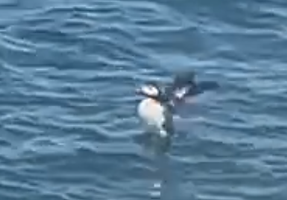
My victory is short lived as my sister is the first to spot the holy grail of nature spotting (for us at least): the puffin. Just the one, but it counts.
And this is the bit where I cleverly weave this all together into some insight about books. Um, avoid using adverbs. Unless you really really want to. Yeah. That’ll do.